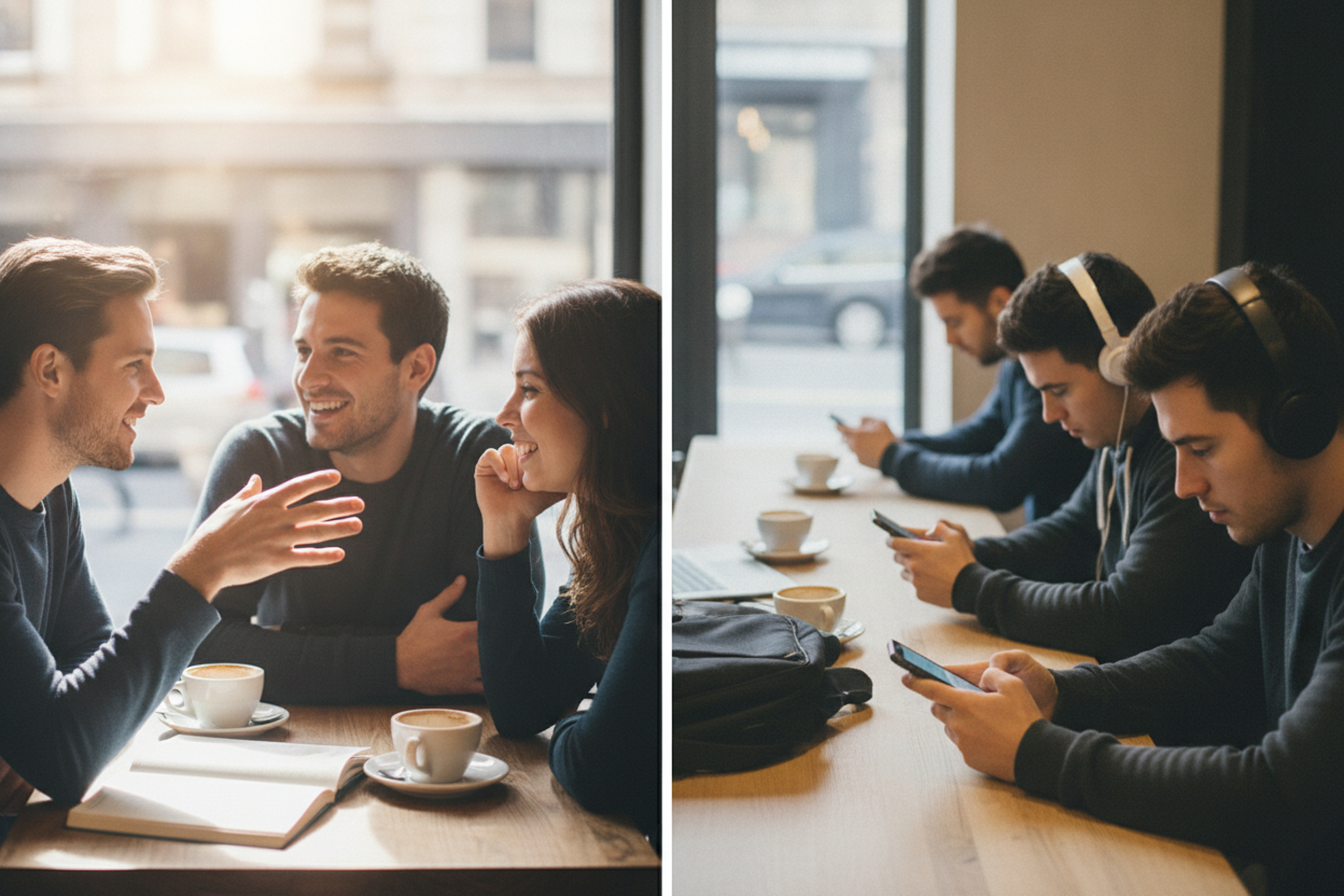
Have We Become Consumers of Conversation, Not Participants?
There was a time when conversation wasn’t something we watched. It was something we did.
Today, many of us spend hours every day consuming communication. We scroll through opinions, watch debates, listen to podcasts, binge interviews, react with emojis and absorb an endless stream of other people’s thoughts.
We consume more conversations than any generation before us. Are we actually participating in fewer conversations than ever as well, I wonder?
There is a profound difference between observing communication and taking part in it.
When we watch a video, nobody asks us a question. Nobody challenges our thinking. Nobody asks us to explain ourselves more clearly. We can stop halfway through, skip ahead or simply scroll on to something else.
Real conversation doesn’t work like that.
It has rhythm. It has uncertainty. It requires attention. Sometimes it flows effortlessly. Sometimes it becomes awkward. Sometimes someone misunderstands us. Sometimes we have to rethink what we were about to say because another perspective has changed the direction of the discussion.
That is where communication is developed.
Not in consumption.
In participation.
Communication isn’t knowledge. It’s a performance skill.
You can’t become a better communicator simply by watching other people communicate, in the same way that you can’t build strength by watching someone else lift weights.
You have to do the repetitions. Every conversation is another repetition.
The brief chat with your neighbour.
The difficult conversation you’ve been avoiding.
The meeting where you finally contribute your idea.
The networking event where you introduce yourself to someone you don’t know.
The dinner table discussion where opinions differ.
The spontaneous question you didn’t see coming.
These are the moments that strengthen our communication muscles. Yet increasingly, we spend our time in environments where we are spectators rather than active contributors.
That has consequences.
Many people feel uncomfortable speaking without preparation. We become anxious when conversations don’t follow a script. We struggle to think aloud, to find the right example, to disagree respectfully, to improvise or to navigate difficult discussions.
Not because we lack intelligence. Because we lack practice.
Online, communication can also become strangely consequence-free. We can remain anonymous. We can comment without seeing the expression on the other person’s face. We can leave the conversation whenever it becomes uncomfortable.
Real conversations ask more of us.
They require empathy. Curiosity. Listening. Adaptability. Presence.
They require us to stay in the room.
Even here on LinkedIn, thousands of people will read a post without ever joining the conversation. Sometimes we comment because we know it helps the algorithm. Sometimes because we want to be seen. But genuine dialogue is different. It isn’t about visibility; it’s about valuable contribution.
It asks us to think, to question, to build on someone else’s idea or even to change our own.
That’s where growth happens.
The more we participate, the more articulate we become. The more confident we become. The more creative we become. We discover better questions, better stories, better metaphors and better ways of connecting seemingly unrelated ideas.
Our thinking becomes sharper because it is tested by other people.
Perhaps that is one of the greatest values of conversation.
It doesn’t simply reveal what we know. It reveals who we are becoming.
So here’s the question I’ve been asking myself lately.
How much of my communication is consumption…
…and how much is participation?
Because the future won’t belong to those who consume the most content.
It will belong to those who can still sit across from another human being, listen with genuine curiosity, contribute something original and create understanding where there wasn’t any before.
Communication, like any muscle, only becomes stronger when we use it.